Viewing Room | Frank Stella. The Duel E, 2001

24 April - 1 June 2026
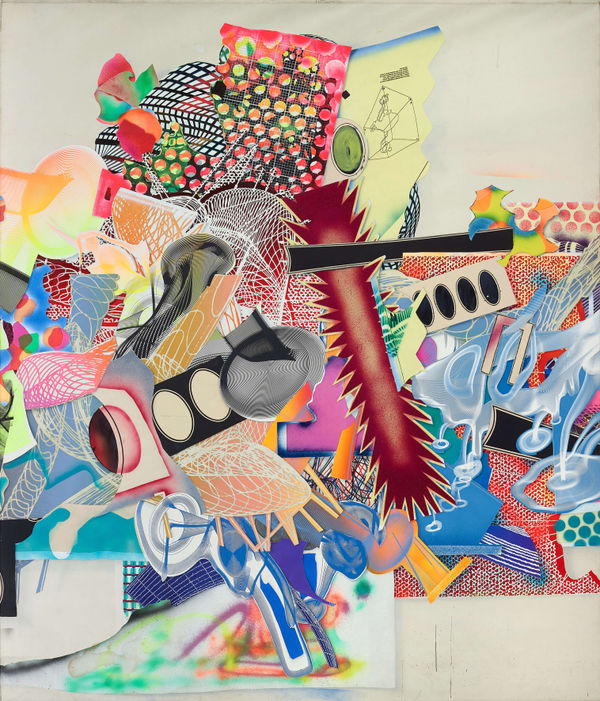
  • Frank Stella. The Duel E, 2001, Acrylic on canvas | 485 x 466 cm Frank Stella. The Duel E, 2001, Acrylic on canvas | 485 x 466 cm Frank Stella. The Duel E, 2001, Acrylic on canvas | 485 x 466 cm

    Frank Stella. The Duel E, 2001

    Acrylic on canvas | 485 x 466 cm
    The Duel E, 2001 is among the most physically commanding works Frank Stella produced in the last two decades of his career — a vast, kinetically charged canvas nearly five metres across, in which the structural logic of late abstraction reaches a point of sustained intensity.
  •  


    Frank Stella and the Expansion of Abstraction

    Few artists have reshaped the trajectory of postwar painting as fundamentally as Frank Stella. Emerging at the end of the 1950s, at a moment when gestural expression had become the dominant language of American art, Stella turned decisively toward structure, clarity, and the unmediated presence of the painted surface.

  • Yet his practice resists simple categorization. Across decades, Stella continuously redefined his language—from the rigor of the Black Paintings to shaped canvases, and later to increasingly complex reliefs and spatial constructions. By the late 1990s and early 2000s, his work had evolved into a dense and expansive form of abstraction that approaches sculpture without abandoning painting. Major retrospectives at the Museum of Modern Art and the Whitney Museum of American Art have underscored both the scale and continuity of this achievement.

  • The Duel Series The Duel works (2001) form part of Stella’s Heinrich von Kleist series (1996–2008), inspired by the writings... The Duel Series The Duel works (2001) form part of Stella’s Heinrich von Kleist series (1996–2008), inspired by the writings... The Duel Series The Duel works (2001) form part of Stella’s Heinrich von Kleist series (1996–2008), inspired by the writings...

    The Duel Series

    The Duel works (2001) form part of Stella’s Heinrich von Kleist series (1996–2008), inspired by the writings of Heinrich von Kleist. Rather than illustrating narrative episodes, Stella translates their psychological intensity into formal terms. The notion of “duel” becomes a structural principle—an interplay of opposing forces embedded within the composition itself.


    These works are defined by layered geometries, sweeping arcs, intersecting grids, and abrupt angular structures that appear to collide and reconfigure across the surface. Industrial techniques—spray paint, stenciling, and digital projection—are combined with painterly processes, producing surfaces that oscillate between control and excess. The result is a visual field that feels unstable and kinetic, as if continually unfolding.

  • Despite their physical flatness, the Duel paintings generate a strong sense of depth and movement. Elements advance and recede simultaneously, creating a spatial ambiguity that recalls constructed relief. Stella’s long-standing concept of “working space” reaches a new intensity here: the canvas operates less as a bounded plane and more as an arena of tension, expansion, and compression.

  • A prominent example from the series, The Duel (Der Zweikampf) F (N#8) (2001), is held in the collection of the...

    Frank Stella. The Duel (Der Zweikampf) F (N#8), 2001 © Frank Stella / Artists Rights Society (ARS), New York

    A prominent example from the series, The Duel (Der Zweikampf) F (N#8) (2001), is held in the collection of the San Francisco Museum of Modern Art. This large-scale work exemplifies Stella’s late approach, where painting begins to operate as a spatial construction.


    Notably, Stella leaves the orientation of the work open—“may be hung either horizontally or vertically,” as noted by the San Francisco Museum of Modern Art—reinforcing its resistance to a fixed compositional reading.


    Within the museum context, the Duel paintings are understood as a focused group within the Kleist cycle, marking a particularly concentrated moment in Stella’s late production.

  • Frank Stella. The Chase – Second Day, 1989, Museum Reinhard Ernst, Wiesbaden, Germany ©VG Bild-Kunst, Bonn; Photo: Martin Url

  • Dialogues and a Late Synthesis


    In the Duel series, Stella moves decisively beyond the logic of reduction that defined his early work, toward a form of abstraction built on density, layering, and internal tension. The image is no longer singular or resolved; it unfolds as a constructed field in which multiple systems intersect and compete.

  • The Duel works invite comparison with three painters who defined the possibilities of postwar abstraction. Like de Kooning, Stella treats... The Duel works invite comparison with three painters who defined the possibilities of postwar abstraction. Like de Kooning, Stella treats... The Duel works invite comparison with three painters who defined the possibilities of postwar abstraction. Like de Kooning, Stella treats...
    The Duel works invite comparison with three painters who defined the possibilities of postwar abstraction. Like de Kooning, Stella treats painting as an open process rather than a resolved object — though where de Kooning achieves instability through gesture, Stella builds it from structure, the composition refusing resolution by design. The surfaces recall Richter's stratified abstractions, where depth is optical rather than physical, emerging from the accumulation and interference of layers. And with Twombly, Stella shares a sustained tension between fragmentation and coherence: a single field holding competing energies — line, mark, and movement — without collapsing into either chaos or order.
  • Within this expanded framework, Duel can be understood as a late synthesis in Stella’s practice. The clarity of his earlier geometry remains embedded within the work, but no longer governs it. Instead, it is absorbed into a more fluid and expansive system, where structure becomes the site of tension, and the painting itself functions as a dynamic, continuously shifting whole.

  • Frank Stella. The Duel E, 2000 © Gary Tatintsian Gallery


  • Explore more works by Artist
    • Frank Stella The Duel B, 2001 Acrylic on canvas 473 × 440 cm
      Frank Stella
      The Duel B, 2001
      Acrylic on canvas
      473 × 440 cm
    • Frank Stella The Duel C, 2001 Acrylic on canvas 472.4 x 434.3 cm
      Frank Stella
      The Duel C, 2001
      Acrylic on canvas
      472.4 x 434.3 cm

  • Find out more


  • Viewing Rooms