Lee Ufan Haman, South Gyeongsang Province, Korea, b. 1936
-
 © Gary Tatintsian Gallery
 -
“If a bell is struck, the sound reverberates into the distance. Similarly, if a point filled with mental energy is painted on canvas; it sends vibrations into the surrounding unpainted space… A work of art is a site where places of making and not making, painting and not painting, are linked so that they reverberate with each other.”
Lives and works in Kamakura (Japan) and Paris (France)

DOWNLOAD CV >
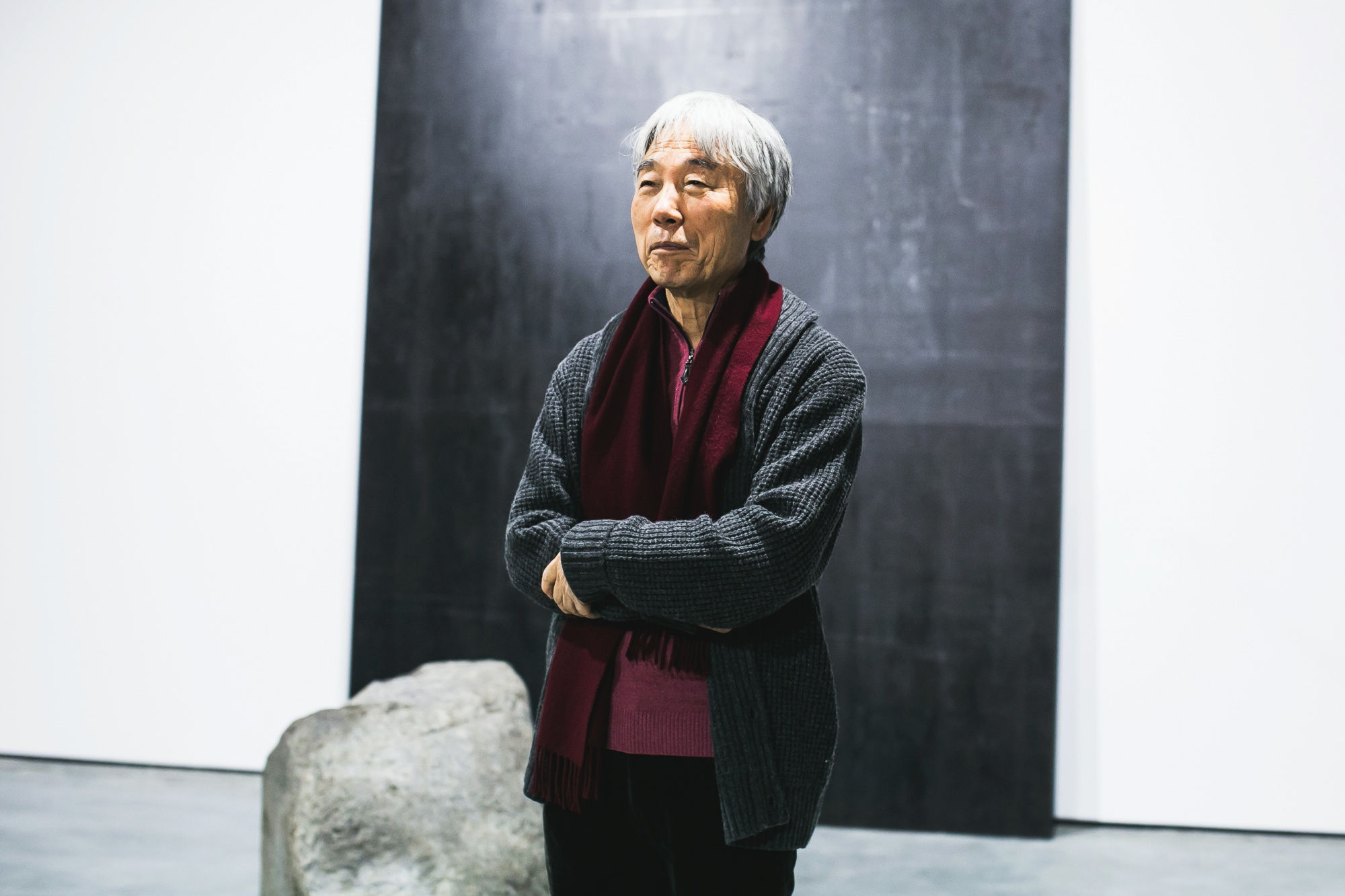
Painter, sculptor, writer, and philosopher, Lee Ufan emerged in the late 1960s as a central theorist and practitioner of the Japanese avant-garde movement Mono-ha (School of Things). As one of the movement’s key intellectual voices, he articulated the artwork as a relational field between materials, space, and perception at a moment when postwar art in East Asia was reassessing modernist paradigms.
Mono-ha proposed neither representation nor expression as primary concerns. Instead, it emphasized encounters between materials—stone, steel, glass, earth—and the spatial conditions in which they exist. Works were constructed with minimal manipulation, allowing raw materials to retain their physical integrity. In this context, Lee’s theoretical writings were foundational, framing the artwork not as an object of mastery but as a relational field in which matter, space, and viewer co-exist.
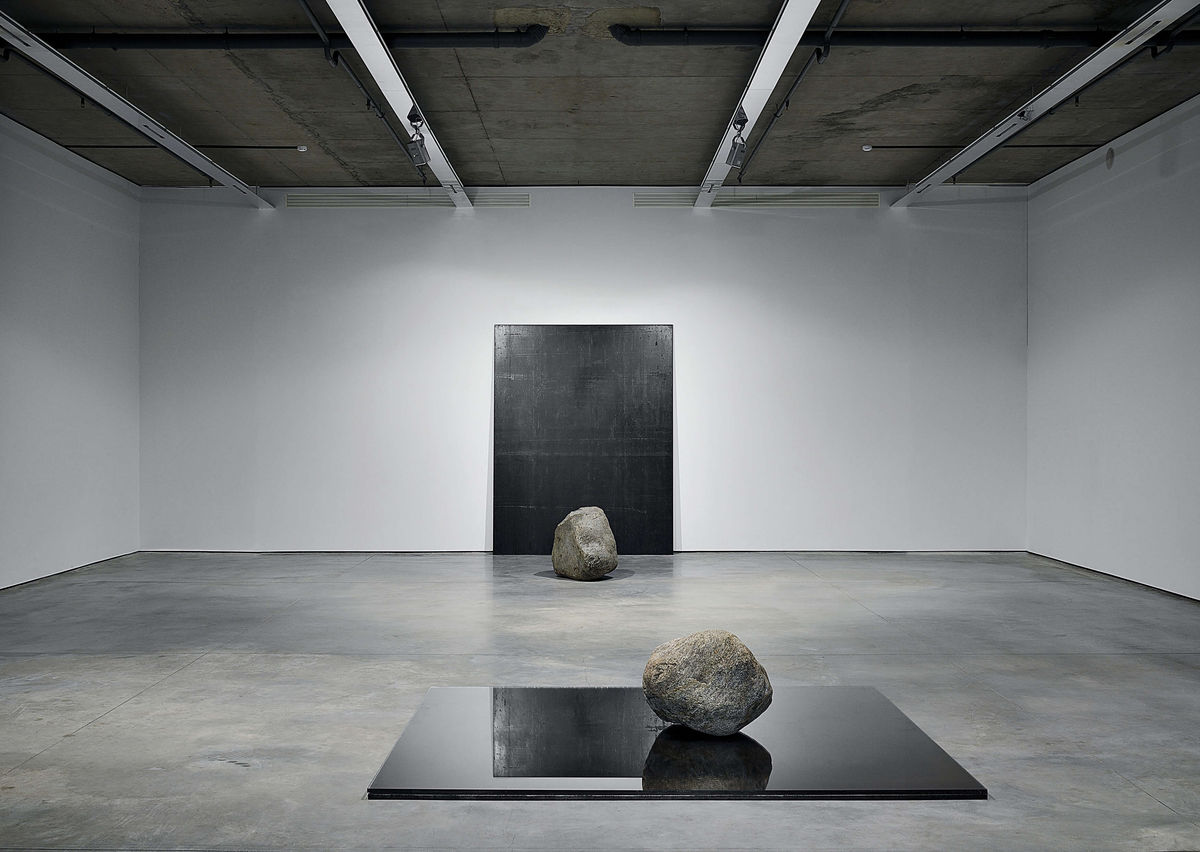
Lee’s sculptural works, often titled Relatum, typically juxtapose industrial steel plates with natural stones and sheets of glass. The precision of the steel—associated with modern construction and human fabrication—meets the geological weight of stone, which resists instrumental logic and evokes deep time. The work does not impose form but stages a condition of tension and coexistence. Meaning arises not from transformation but from relation.
“If a heavy stone happens to hit glass, the glass breaks. That happens as a matter of course. But if an artist’s ability to act as a mediator is weak, there will be more to see than a trivial physical accident. Then again, if the breakage conforms too closely to the intention of the artist, the result will be dull. It will also be devoid of interest if the mediation of the artist is haphazard. Something has to come out of the relationship of tension represented by the artist, the glass, the stone. It is only when a fissure results from the cross-permeation of the three elements in this triangular relationship that, for the first time, the glass becomes an object of art.” – Lee Ufan
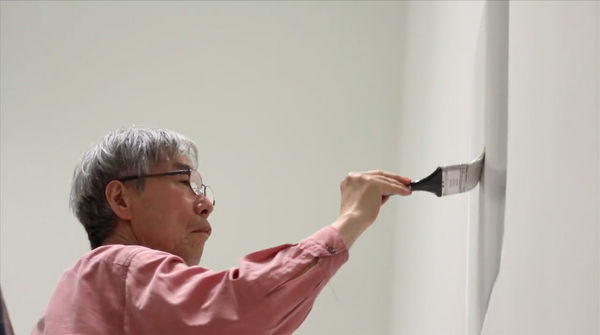
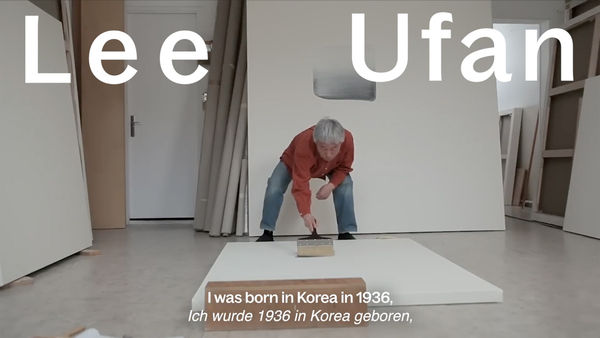
This philosophy of mediation—between action and restraint, intervention and non-intervention—finds its most distilled articulation in Lee’s painting practice. In the Dialogue series, initiated in the 1970s and sustained over decades, Lee applies one or several measured, viscous brushstrokes to an otherwise unpainted canvas. Each stroke is executed slowly, the brush gradually exhausting its pigment as it moves across the surface. The fading trace records duration and resistance, making visible the passage of time within the act of painting.
The surrounding white field is not emptiness but an active, responsive space. Rather than asserting composition, the painted mark establishes a condition of encounter: pigment and void, gesture and stillness, presence and absence remain in tension. The canvas becomes a site where what is painted and what is left untouched coexist. In Lee’s own terms, it forms “an open site of power,” in which the work emerges not from accumulation, but from the dynamic relation between mark and space.
Lee Ufan received the Praemium Imperiale for Painting in 2001 and the UNESCO Prize in 2000. His work was featured at the Venice Biennale in 2011, affirming his position as a major figure in postwar and contemporary art.
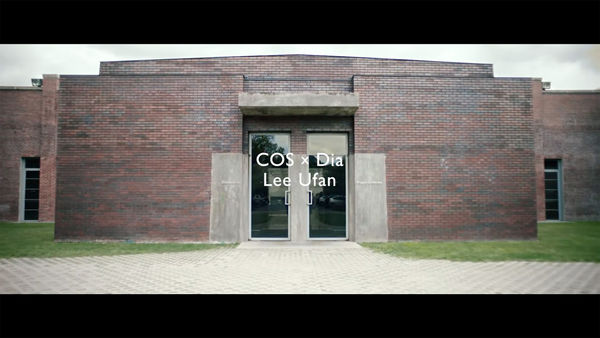
In 2010, the Lee Ufan Museum opened in Naoshima, Japan. Designed by Tadao Ando, the museum presents a permanent installation of paintings and sculptures spanning from the 1970s to the present, situating Lee’s work within an architectural environment defined by light, concrete, and landscape.
Over the past decades, Lee Ufan’s work has been presented in major international institutions, reflecting his sustained influence within global contemporary art discourse:
Solomon R. Guggenheim Museum, New York
Tate Modern, London
Jeu de Paume, Paris
National Art Center Tokyo, Tokyo
Yokohama Museum of Art, Yokohama
Musée d’Art Moderne de Saint-Étienne Métropole, Saint-Étienne
Kunstmuseum Bonn, Bonn
Rijksmuseum, Amsterdam
Art Gallery of New South Wales, Sydney
Hamburger Bahnhof – Nationalgalerie der Gegenwart, Berlin
Dia Beacon, New York
-
-
Exhibitions
-
Publications
-
Viewing Rooms
-
News
-
Lee Ufan | Quiet Resonance
August 31, 2024 – September 2025 | Art Gallery of New South Wales, SydneyWithin spaces designed by the Lee Ufan, this exhibition distills over six decades of considered experimentation into a series of recent paintings and sculptures created especially for the Art Gallery... -
Lee Ufan | Personal Exhibition at Hamburger Bahnhof
October 27, 2023 – April 28, 2024 | Hamburger Bahnhof, BerlinHamburger Bahnhof presents the first comprehensive retrospective of the painter and sculptor Lee Ufan in Germany. The exhibition includes some of artist’s most significant pieces, including works from his iconic... -
Lee Ufan | Relatum
May 28 – October 27, 2024 | Rijksmuseum gardens, AmsterdamNine works by Lee Ufan from the artist’s Relatum series are represented in the gardens of the Rijksmuseum in Amsterdam, marking the first solo exhibition of the artist in the... -
Lee Ufan | Personal Exhibition at Hyogo Prefectural Museum Of Art
December 13, 2022 – February 12, 2023 | Hyogo Prefectural Museum Of Art, KobeThe major retrospective exhibition assembles Lee Ufan most important works, including everything from his earliest pre-Mono-ha pieces, which considered the problem of vision, the Relatum series, which changed the concept... -
Lee Ufan | 15th Anniversary of the National Art Center
August 10 – November 7, 2022 | The National Art Center, TokyoThe exhibition assembles Lee Ufan most important works, including everything from his earliest pre-Mono-ha pieces, which considered the problem of vision, the Relatum series, which changed the concept of sculpture,...
-
-
Video



 Facebook
 Twitter
 Instagram
 Pinterest
 Artsy
Artsy Subscribe