Online Viewing Room | Peter Saul

28 January - 10 March 2026
  • Peter Saul. Selected Bad Paintings 1934, San Francisco, CA, USA. Lives and works in New York, NY, USA. Peter Saul...
    Peter Saul. Selected Bad Paintings 1934, San Francisco, CA, USA. Lives and works in New York, NY, USA. Peter Saul...
    Peter Saul. Selected Bad Paintings 1934, San Francisco, CA, USA. Lives and works in New York, NY, USA. Peter Saul...
    Peter Saul. Selected Bad Paintings 1934, San Francisco, CA, USA. Lives and works in New York, NY, USA. Peter Saul...
    Peter Saul. Selected Bad Paintings 1934, San Francisco, CA, USA. Lives and works in New York, NY, USA. Peter Saul...
    Peter Saul. Selected Bad Paintings 1934, San Francisco, CA, USA. Lives and works in New York, NY, USA. Peter Saul...

    Peter Saul. Selected Bad Paintings

    1934, San Francisco, CA, USA. Lives and works in New York, NY, USA.


    Peter Saul is widely regarded as one of the most influential and distinctive American painters of the postwar era. Combining the expressive intensity of Pop Art with the wit of underground comics and the critical insight of social satire, Saul developed a distinctly personal style that has consistently defied categorization.

  • Often described as a “violator of good taste,” Saul’s paintings merge vivid color, cartoon imagery, and expressive distortion into charged...
    Peter Saul © Gary Tatintsian Gallery

    Often described as a “violator of good taste,” Saul’s paintings merge vivid color, cartoon imagery, and expressive distortion into charged compositions that reflect the contradictions of contemporary society. His pioneering role in the emergence of Bad Painting—a term associated with deliberately anti-academic, expressive figuration—established him as a central figure in contemporary painting and a touchstone for later artists including Sue Williams, Kara Walker, Robert Melee, and Carroll Dunham.

  • Over a career spanning more than seven decades, Saul has maintained a dialogue between mass culture and the history of art. In the 1950s, he began incorporating comic and cartoon figures such as Superman and Donald Duck into expressionist compositions, confronting high art with popular iconography.

    In the 1960s, he produced paintings that served as fierce indictments of war and political authority, responding to the Vietnam conflict. During the 1970s, he reinterpreted canonical works—among them Rembrandt’s The Night Watch and Picasso’s Guernica—recasting them through his own acerbic lens. Throughout his practice, Saul has balanced parody with critique, transforming humor, excess, and contradiction into vehicles for reflection on both image and ideology.


    Beneath their apparent irreverence, Saul’s paintings reveal a sustained engagement with the history of modern art. His mastery of composition, color, and structure enables him to construct layered dialogues between cultural commentary, formal exploration, and autobiographical reference. Through this synthesis, Saul has articulated a distinctive and provocative vision that invites viewers to reconsider social values and confront the psychology of contemporary experience.

  • "The important thing is that a work has to look fresh, to be as original as possible. That means it has to have its own idea and psychology. I try to make it worth looking at, to turn it into a sensation. True or false doesn't matter at all as long as it's disturbing or funny, because I love all psychology. Bad things make me laugh just as often as good things. This has been my art style for over 55 years. I am open to any humor, except sophisticated humor. Too many good artists have sought after it. The secret of the success of a "bad" artist is in overcoming the need for approval,"

    - Peter Saul 

  • In 2020, the New Museum in New York presented a major retrospective, Peter Saul: Crime and Punishment, curated by Massimiliano Gioni and Gary Carrion-Murayari, celebrating the artist’s groundbreaking contributions to contemporary art.


    Works by Peter Saul are held in major international collections, including the Metropolitan Museum of Art, New York; Museum of Modern Art (MoMA), New York; Whitney Museum of American Art, New York; Centre Pompidou, Paris; Museum Ludwig, Cologne; Stedelijk Museum, Amsterdam; Museum of Contemporary Art (MOCA), Los Angeles; and the Art Institute of Chicago.


  • Works
    • Peter Saul Fall of Constantinople (1453 A.D.), 2004 Acrylic on canvas 198 x 274 cm
      Peter Saul
      Fall of Constantinople (1453 A.D.), 2004
      Acrylic on canvas
      198 x 274 cm
    • Peter Saul Girl Trouble II, 1987 Oil and acrylic on canvas 90 x 72 in 228,6 x 182,9 cm
      Peter Saul
      Girl Trouble II, 1987
      Oil and acrylic on canvas
      90 x 72 in
      228,6 x 182,9 cm
    • Peter Saul Return to the Alamo, 2017 Acrylic / canvas 198 x 305 cm
      Peter Saul
      Return to the Alamo, 2017
      Acrylic / canvas
      198 x 305 cm
    • Peter Saul Sardanapalus, 2005 Acrylic on canvas 198 × 218,4 cm
      Peter Saul
      Sardanapalus, 2005
      Acrylic on canvas
      198 × 218,4 cm
    • Peter Saul Self-Defense, 1969 Acrylic on canvas 68 x 96 in 172,7 x 243,8 cm
      Peter Saul
      Self-Defense, 1969
      Acrylic on canvas
      68 x 96 in
      172,7 x 243,8 cm
    • Peter Saul Wall Street Suicide, 2012 Acrylic on canvas 178 × 152 cm
      Peter Saul
      Wall Street Suicide, 2012
      Acrylic on canvas
      178 × 152 cm
  • Fall Of Constantinople (1453 A.D.), 2004 Acrylic on canvas 198 x 274 cm Fall Of Constantinople (1453 A.D.), 2004 Acrylic on canvas 198 x 274 cm Fall Of Constantinople (1453 A.D.), 2004 Acrylic on canvas 198 x 274 cm Fall Of Constantinople (1453 A.D.), 2004 Acrylic on canvas 198 x 274 cm

    Fall Of Constantinople (1453 A.D.), 2004


    Acrylic on canvas

    198 x 274 cm

  • "You never know about the art world because it's a matter of opinion. If you look at old art like Rembrandt and Vermeer, it's not completely a matter of opinion. The pictures confront you, and you see exactly what it is. In modern art, a lot of it is suggestive, and it becomes a matter of opinion... 

    My idea of what Constantinople looked like in 1453 comes from a sixteenth century illustration in John Norwich’s “Byzantium, the Decline and Fall,” a very good account of the final battle as well as having a portrait of Mehmet II, the Turkish conqueror on the cover. However, aside from those two helpful illustrations, I paid no attention to the historical facts. That’s because my picture has to be interesting to look at in today’s art world, not a history classroom.” – Peter Saul

  • Peter Saul. Fall Of Constantinople (1453 A.D.), 2004  © Gary Tatintsian Gallery

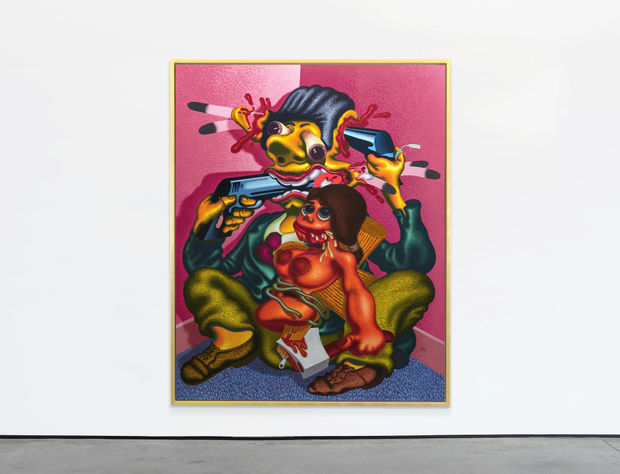
  • Girl Trouble II, 1987 Oil and acrylic on canvas 90 x 72 in. / 228,6 x 182,9 cm Peter Saul’s... Girl Trouble II, 1987 Oil and acrylic on canvas 90 x 72 in. / 228,6 x 182,9 cm Peter Saul’s... Girl Trouble II, 1987 Oil and acrylic on canvas 90 x 72 in. / 228,6 x 182,9 cm Peter Saul’s... Girl Trouble II, 1987 Oil and acrylic on canvas 90 x 72 in. / 228,6 x 182,9 cm Peter Saul’s...

    Girl Trouble II, 1987


    Oil and acrylic on canvas

    90 x 72 in. / 228,6 x 182,9 cm


    Peter Saul’s distortions of the human face and body draw from the figurative deformations seen in expressionist and surrealist art. Like Picasso, de Kooning, and Bacon, Saul’s figures are often viewed as formal experiments.

  • However, his work is infused with sarcastic humor and intentionally embraces cruelty and parody, giving it a more biting edge. Saul’s figures are not just distorted for visual impact—they are crafted to provoke the viewer, pushing them to confront the unsettling imagery and explore the deeper meanings beneath. By focusing on topical subjects, Saul encourages audiences to engage with the discomfort his work elicits and reconsider its underlying messages.


    “All my work can be professionally seen as the artistic contribution that should, and did come after + stem from Francis Bacon. This contribution was not accepted as a contribution because it was a time when people were only interested in the visual appearance of the over-all picture and unable to reflect on the “meaning” of the figurative elements. I got people to interpret my figures only thru dealing with topical subjects, and then mainly complaints like “how the hell am I supposed to appreciate your technique if you keep painting these exciting scenes that are hard to ignore.” – Peter Saul

  • Peter Saul. Girl Trouble II, 1987 © Gary Tatintsian Gallery
  • Return to the Alamo, 2017 Acrylic on canvas 198 x 305 cm Peter Saul’s 'Return to the Alamo', 2017 offers... Return to the Alamo, 2017 Acrylic on canvas 198 x 305 cm Peter Saul’s 'Return to the Alamo', 2017 offers... Return to the Alamo, 2017 Acrylic on canvas 198 x 305 cm Peter Saul’s 'Return to the Alamo', 2017 offers... Return to the Alamo, 2017 Acrylic on canvas 198 x 305 cm Peter Saul’s 'Return to the Alamo', 2017 offers... Return to the Alamo, 2017 Acrylic on canvas 198 x 305 cm Peter Saul’s 'Return to the Alamo', 2017 offers...

    Return to the Alamo, 2017


    Acrylic on canvas

    198 x 305 cm


    Peter Saul’s 'Return to the Alamo', 2017 offers a subversive reimagining of the storied 1836 battle, where outnumbered Texan forces made a doomed stand against the Mexican army. Saul’s engagement with the Alamo draws from earlier artistic depictions, such as Henry Arthur McArdle’s romanticized 1905 painting 'Dawn at the Alamo' and John Wayne’s 1960 film 'The Alamo', both of which reinforce narratives of sacrifice and valor. Yet, in Return to the Alamo, Saul subverts these portrayals with his signature distortion and irreverence, distilling history into chaotic, cartoonish energy rather than reverential grandeur.

  • Rather than adhering to heroic or solemn interpretations, Saul transforms the historical event into a vivid spectacle, fusing Surrealism and Pop Art with garish hues and grotesquely exaggerated figures. His formal approach bridges the melting, elastic forms of Salvador Dalí with the frenetic brushwork of Willem de Kooning, merging the intersection of history and the visual absurd, prompting viewers to question how history is constructed, remembered, and mythologized.

    “I’m interested in history, but I’m not interested in it as a narrative. I’m interested in it as a bunch of crazy stuff that happened.” – Peter Saul

  • Peter Saul. Return to the Alamo, 2017 © Gary Tatintsian Gallery

  • Sardanapalus, 2005 Acrylic and oil on canvas 198 x 218,4 cm 'Sardanapalus', 2005 by Peter Saul is an appropriation and... Sardanapalus, 2005 Acrylic and oil on canvas 198 x 218,4 cm 'Sardanapalus', 2005 by Peter Saul is an appropriation and... Sardanapalus, 2005 Acrylic and oil on canvas 198 x 218,4 cm 'Sardanapalus', 2005 by Peter Saul is an appropriation and... Sardanapalus, 2005 Acrylic and oil on canvas 198 x 218,4 cm 'Sardanapalus', 2005 by Peter Saul is an appropriation and... Sardanapalus, 2005 Acrylic and oil on canvas 198 x 218,4 cm 'Sardanapalus', 2005 by Peter Saul is an appropriation and...

    Sardanapalus, 2005


    Acrylic and oil on canvas

    198 x 218,4 cm


    'Sardanapalus', 2005 by Peter Saul is an appropriation and reinterpretation of a plot from 'The Death of Sardanapalus', 1827 by the French painter Eugène Delacroix.


    The legend says that the Assyrian king Sardanapalus was the last of the line of 30 kings of Assyria. He surpassed all his predecessors in his dissolute living, which led to the fall of the whole empire. Failing to quell the rebellions, Sardanapalus resolves to end his life and consign to fire all his servants and the royal treasures.

  • Delacroix's painting was first exhibited in the Paris Salon of 1827–28 and immediately provoked a strong public resonance. It was...

    Eugène Delacroix. The Death of Sardanapalus, 1827

    Delacroix's painting was first exhibited in the Paris Salon of 1827–28 and immediately provoked a strong public resonance. It was criticized for artist's use of perspective and for the chaos that prevailed in the foreground.


    Some critics called it a "bad painting" and a symbol of "fanatical arrogance." The work would later be recognized as one of the major innovations for figurative painting, to become a permanent exhibit in the Louvre collection.

  • In his work, Dalacroix succeeded to simultaneously shock and captivate the viewer. Peter Saul expanded this idea to its limits, turning the 'bad painting' into the quintessence of his iconic style. In Saul's work, the distorted perspective dramatically transforms the anatomy, the acidic, psychedelic colors and the chaotic composition create a vibrant drama and an incessant dialogue with the viewer.

    "I'm not against history paintings, I just want to add my own flavor to it."

    – Peter Saul

  • Peter Saul. Sardanapalus, 2005 © Gary Tatintsian Gallery
  • Self-Defense, 1969 Acrylic on canvas 172,7 x 243,8 cm 'Self-Defense' is a groundbreaking painting in which Peter Saul challenged sixties... Self-Defense, 1969 Acrylic on canvas 172,7 x 243,8 cm 'Self-Defense' is a groundbreaking painting in which Peter Saul challenged sixties... Self-Defense, 1969 Acrylic on canvas 172,7 x 243,8 cm 'Self-Defense' is a groundbreaking painting in which Peter Saul challenged sixties... Self-Defense, 1969 Acrylic on canvas 172,7 x 243,8 cm 'Self-Defense' is a groundbreaking painting in which Peter Saul challenged sixties... Self-Defense, 1969 Acrylic on canvas 172,7 x 243,8 cm 'Self-Defense' is a groundbreaking painting in which Peter Saul challenged sixties...

    Self-Defense, 1969


    Acrylic on canvas

    172,7 x 243,8 cm


    'Self-Defense' is a groundbreaking painting in which Peter Saul challenged sixties America to consider its rising social tensions. Created in 1969, during the height of the Black Panther movement, it stands as one of the key works in Saul’s series of politically charged paintings from that era, highlighting the civil rights struggles and societal conflicts of the time.
  • “I wanted my art…not to be in the middle. My feeling about politics in art is that it’s usually feeble, because it delivers the expected message. The expected message is dead on arrival, because all it does is point out that the good guys are good, the bad guys are bad. I wanted work that was far, far more troubling. If a picture isn’t troubling, why even think about it?” – Peter Saul


  • Saul’s approach to art often includes elements of humor and satire, even when addressing serious social issues. 'Self-Defense' depicts academic...
    © The Oregonian Archives / MetroWest / Hartford Times Collection / Bettmann Archive

    Saul’s approach to art often includes elements of humor and satire, even when addressing serious social issues. 'Self-Defense' depicts academic and activist Angela Davis, who was persecuted by the U.S. government for her involvement with the Black Panthers, defending herself against a pair of police officers whose distended forms reach across a caricatured version of the Golden Gate Bridge. This artwork reflected Saul’s position at the forefront of the counterculture and his engagement with pressing questions of race and inequality.


    Combining hyperchromatic Day-Glo colors and caricatures of American culture, Saul employed his signature style to push the boundaries of what painting can achieve. The work went beyond what other pop-art artists dared to explore, making a bold statement through its vivid and provocative imagery.

  • Peter Saul. Self-Defense, 1969 © Gary Tatintsian Gallery

  • Wall Street Suicide, 2012 Acrylic on canvas 178 x 152 cm Saul's works, rambunctious and full of lush images and... Wall Street Suicide, 2012 Acrylic on canvas 178 x 152 cm Saul's works, rambunctious and full of lush images and... Wall Street Suicide, 2012 Acrylic on canvas 178 x 152 cm Saul's works, rambunctious and full of lush images and... Wall Street Suicide, 2012 Acrylic on canvas 178 x 152 cm Saul's works, rambunctious and full of lush images and... Wall Street Suicide, 2012 Acrylic on canvas 178 x 152 cm Saul's works, rambunctious and full of lush images and...

    Wall Street Suicide, 2012


    Acrylic on canvas

    178 x 152 cm


    Saul's works, rambunctious and full of lush images and poisonous morality, portray a new reality by removing the mask of hypocrisy and exposing human vices, in such a way that can change our perception of history and the generally accepted understanding of social norms. As the originator of Pop Art, Peter Saul embodied his ideas in an unprecedented style of painting that inspired a generation of American artists to new thinking and new creativity, which became the foundation of modern American culture.

  • Each of Peter Saul's works weaves together multiple cultural layers. In Wall Street Suicide, Édouard Manet’s provocative imagery collides with the surreal, distorted figures of Francis Bacon and the enduring American icon of Frankenstein—both dead and alive. The painting’s bold use of color and jarring, exaggerated aesthetic exemplify Saul’s painterly mastery and his uniquely probing approach to contemporary themes.

  • "The important thing is that a work has to look fresh, to be as original as possible. That means it has to have its own idea and psychology. I try to make it worth looking at, to turn it into a sensation. True or false doesn't matter at all as long as it's disturbing or funny, because I love all psychology. Bad things make me laugh just as often as good things. This has been my art style for over 55 years. I am open to any humor, except sophisticated humor. Too many good artists have sought after it. The secret of the success of a "bad" artist is in overcoming the need for approval."

    – Peter Saul

  • Peter Saul. Wall Street Suicide, 2012 © Gary Tatintsian Gallery

  • Explore more works by Artist

  • Find out more

  • Viewing Rooms